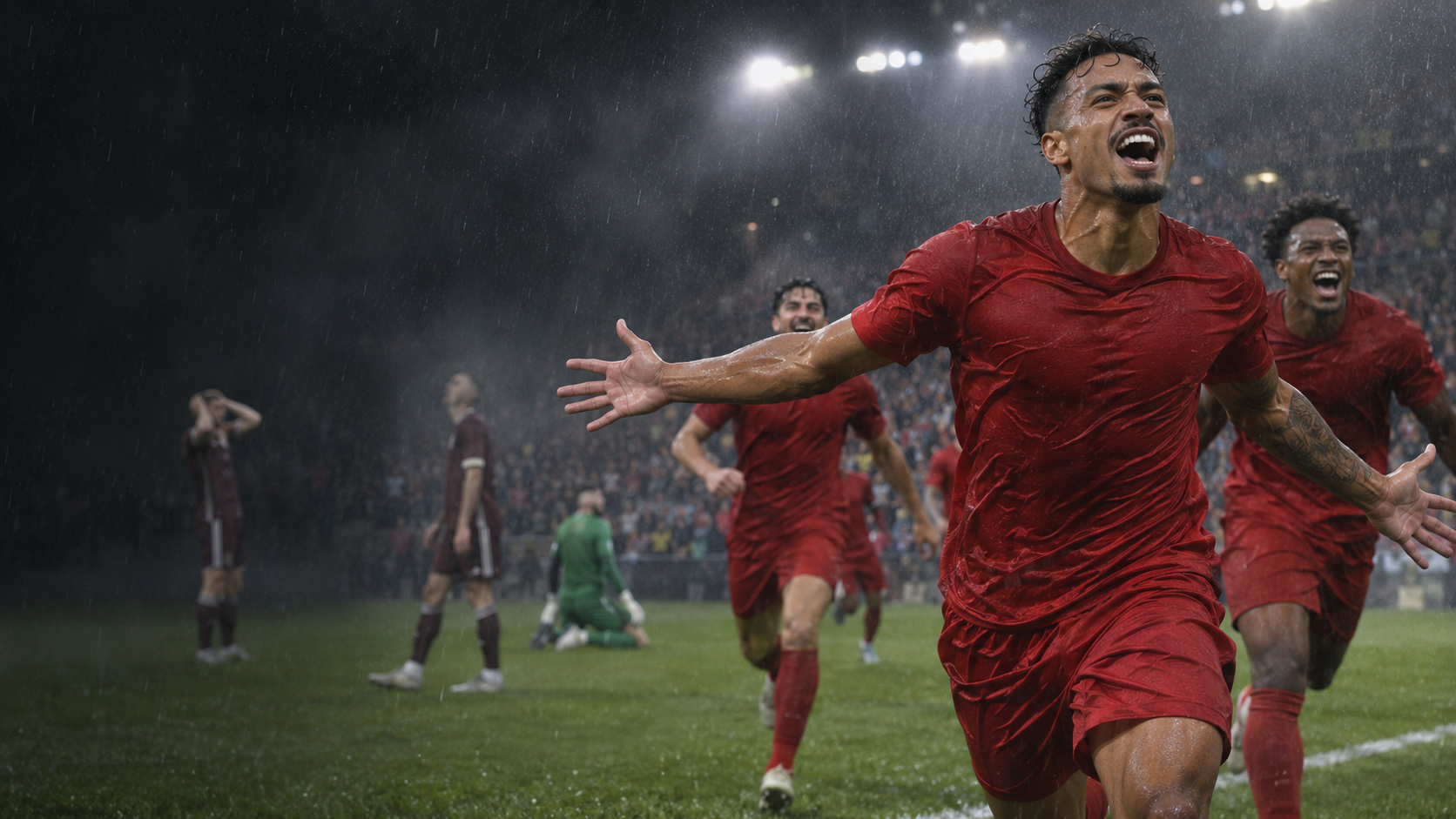
Cunha Scores Twice as United Complete Roma Comeback
Cunha Scores Twice as Manchester United Complete Roma Comeback
Manchester United recovered from a two-goal deficit to defeat Roma 3–2 in a dramatic Champions League comeback led by Matheus Cunha.
Cunha scored twice and completed four successful dribbles, making him United’s decisive attacking player. The victory also ended the club’s reported 54-day wait for a win. Source 1
Roma established a 2–0 lead, but United responded with three second-half goals. A red card added further tension to the closing stages, forcing United to defend their advantage under pressure. Source 9
Roma Take Control Early
The 0–2 scoreline placed United in an immediate crisis. Roma had created a commanding advantage, leaving United with little margin for error. The deficit required the visitors to attack more urgently while avoiding the defensive exposure that often follows an aggressive response.
Game state explains the difficulty. Two goals down, a chasing side must push its defensive line higher and commit more players ahead of the ball, which shortens the distance the opponent needs to cover to reach the penalty area. Every extra attacker improves the chance of sustaining pressure and reduces protection if possession is lost. Solving that trade-off — accepting risk to create chances without conceding a third — is the central problem of any 0–2 recovery, and it is why comebacks of this size remain rare rather than routine.
United also had to remain composed. A third Roma goal would have made the comeback substantially more difficult, while the early disadvantage tested the team’s mentality and organization. According to the supplied match summaries, United ultimately produced a three-goal second-half recovery. Source 3
The match was also temporarily halted after United supporters threw tennis balls onto the pitch. The interruption added to the chaotic atmosphere but does not explain the footballing turnaround. Source 3
That distinction matters for reading the result. The stoppage is a crowd-conduct story, and the summaries treat it as a separate event alongside the scoreline rather than as a cause of it. Restarting after a delay can interrupt rhythm, but no supplied source attributes any of the five goals to the pause, so the comeback should be credited to the second-half performance rather than to the interruption.
Cunha Changes the Game
Cunha provided the attacking spark United needed. His two goals formed the central contribution, while his four successful dribbles showed that his influence extended beyond finishing. Source 1
Two goals and four completed dribbles describe two different kinds of value. Goals decide matches; completed dribbles describe how a team escapes pressure and moves the ball into areas where goals become possible. A player who supplies both reduces a side’s dependence on elaborate passing patterns, because carrying the ball past the first defender does the work a sequence of passes would otherwise have to do.
His ability to beat defenders one-on-one helped United advance the ball and attack more directly. Dribbling past the first defender can force an entire defensive line to adjust, creating space for further attacks. When one defender is beaten, a teammate must cover, and that rotation is what opens the passing lane or the shooting angle that did not exist a second earlier.
Cunha’s first goal reduced the deficit and changed the emotional balance of the match. United no longer needed three goals merely to draw level; they had a realistic route back into the contest. His second goal completed the brace and gave United the lead in a comeback that had initially seemed unlikely. Source 9
The scoring sequence is also a study in momentum. Each goal lowers the next one’s psychological cost: the side that trails by one attacks with belief, while the side that led comfortably starts playing the scoreboard instead of the game. The summaries credit Cunha as United’s decisive player without recording shot counts or expected goals, so his finishing efficiency cannot be quantified beyond the two goals and four dribbles already reported.
How United Turned 0–2 Into 3–2
United increased the tempo, moved the ball forward more quickly and placed greater pressure on Roma’s defensive structure. More attacking numbers created additional passing options and helped United recover second balls near the penalty area.
That approach carried risks. Advancing more players left space for Roma to exploit in transition, so United needed to balance attacking ambition with defensive structure. Cunha’s ball-carrying helped manage that tension by allowing him to progress possession without relying solely on longer passes or elaborate combinations.
Second balls deserve separate attention. When a defence clears under pressure, the ball often lands 20 to 30 yards from goal rather than travelling the length of the pitch. Winning those loose balls keeps the attack alive and pins the defending team inside its own box, which is why sustained pressure so often produces goals that look scrappy rather than constructed. Recovering them requires midfielders and full-backs to hold advanced positions — the same positions that leave space behind if the ball breaks the other way.
Roma’s early control did not survive United’s second-half response. A team defending a lead can become vulnerable if it retreats too deeply or struggles to retain possession. United used the resulting pressure to recover the ball higher up the pitch and bring more attackers into the final third. Source 5
The 42 described the win as a stunning second-half comeback without publishing further match detail, so the mechanism above is the general logic of such a swing rather than a reported account of United’s tactical changes or substitutions. What is documented is the outcome: three second-half goals after a 0–2 deficit. Source 5
Red Card Adds Late Drama
A red card shaped the final phase of the match and made United’s task more difficult. The available summaries do not identify the dismissed player, the disciplinary reason or the exact time of the incident, so those details cannot be stated confidently. Source 9
The dismissal reduced one team’s numbers and increased the importance of defensive spacing, concentration and possession management. United had to protect its lead rather than continue attacking with the same level of risk.
Playing a player short compresses the available covering distance for everyone else. The remaining defenders must defend a wider area, which usually means dropping deeper and conceding territory deliberately. On the ball, the short-handed side wants to keep possession for longer spells, accept fewer forward passes and use the corners as holding areas. Off the ball, it wants to delay rather than press, and to concede set pieces reluctantly rather than free shots from the edge of the box.
The closing stages therefore required discipline. United needed to manage second balls, clear danger effectively and slow the match whenever possible. The red card ensured that the victory would be remembered for both its attacking comeback and its tense conclusion.
Readers should treat any specific claim about the dismissal — the player, the offence, the minute — as unverified until a fuller report appears. The summaries record that the card shaped the match; they do not record its details. Source 9
What the Result Means
The victory ended a reported 54-day wait for a Manchester United win. That statistic adds emotional significance to a result that already carried considerable drama. Source 3
Fifty-four days is a little under eight weeks. A winless run of that length dominates the training-ground agenda, colours every post-match press conference and turns each fixture into a referendum on the manager’s methods. The summaries do not specify which competitions those matches spanned, so the run’s exact weight cannot be measured in league points.
United can take confidence from recovering from 0–2 down, scoring three second-half goals and surviving the red-card complication. However, one comeback does not eliminate the team’s wider concerns. United still needs better starts, stronger game management and greater discipline.
For Roma, the defeat represents a significant missed opportunity. The team converted a 2–0 lead into a loss after United increased the tempo. The result raises broad questions about Roma’s ability to retain possession, defend under sustained pressure and manage a match after taking control.
Context on coverage is worth noting: NewsCord’s report compared accounts from 21 outlets, which means the broad outlines of the scoreline, Cunha’s brace and the red card are consistently reported across multiple sources rather than resting on a single account. Source 9
Final Verdict
Manchester United defeated Roma 3–2 after falling two goals behind, completing a memorable Champions League comeback. Matheus Cunha scored twice, completed four successful dribbles and supplied the decisive individual quality. A red card made the closing stages even more demanding, while the victory ended United’s reported 54-day wait for a win.
Cunha was the defining player, but the result also reflected United’s collective resilience. The team responded to a difficult opening, produced three second-half goals and held on through a chaotic finish.
The victory offers encouragement without guaranteeing a revival. Consistency will determine whether the Roma comeback becomes a genuine turning point or remains one memorable result in an uneven season.
FAQ
Who scored for Manchester United against Roma?
Matheus Cunha scored twice in Manchester United’s 3–2 comeback victory. The supplied summaries do not identify the scorer of United’s third goal.
What was the final score?
Manchester United defeated Roma 3–2 after falling 0–2 behind.
How many goals did Matheus Cunha score?
Matheus Cunha scored two goals.
How many successful dribbles did Cunha complete?
Cunha completed four successful dribbles, according to the supplied match summary. Source 1
Why was the match so dramatic?
United fell 0–2 behind before scoring three second-half goals. A red card shaped the closing stages, and the match was temporarily halted after tennis balls were thrown onto the pitch. Source 3
Was this Manchester United’s first win in 54 days?
Yes. The supplied source summary describes the 3–2 victory over Roma as Manchester United’s first win in 54 days. Source 3
Which details remain unconfirmed?
The dismissed player, the reason for the red card and the minute of the incident are not given in the summaries. The identity of United’s third scorer and the timing of individual goals are also unrecorded. Source 9
How widely was the result reported?
NewsCord’s account compared coverage from 21 outlets, and The 42 independently described a stunning second-half comeback. Source 9