How One Trapped Antimatter Particle Could Transform Physics
How One Trapped Antimatter Particle Could Transform Physics
A single antimatter particle confined inside an electromagnetic trap can become a precision instrument for testing the laws of nature.
Scientists do not need large quantities of antimatter to ask major questions. One trapped particle can be isolated from ordinary matter, monitored repeatedly, and compared with theoretical predictions. Its charge, mass, magnetic properties, motion, and response to external fields may reveal whether matter and antimatter follow exactly matching rules.
That possibility explains the excitement surrounding claims that a particle in a “cage” could open the door to revolutionary physics. The phrase describes the method’s potential importance, not proof that established physics has failed. Any unexpected result would require rigorous uncertainty analysis, repeated measurements, and independent confirmation.
The central achievement is control: producing antimatter, preventing it from touching matter, and measuring it accurately enough to test fundamental symmetries.
What Is Antimatter?
The Mirror Partner of Ordinary Matter
Antimatter consists of particles related to ordinary matter particles. An antimatter particle has the same mass as its corresponding matter particle but the opposite electric charge or other reversed quantum properties.
Examples include:
- An electron and a positron.
- A proton and an antiproton.
- Hydrogen and antihydrogen.
A positron has the same mass as an electron but a positive rather than negative electric charge. An antiproton has the same mass as a proton but a negative charge. Antihydrogen combines a positron with an antiproton, creating the antimatter counterpart of ordinary hydrogen.
When matter and antimatter meet, they can annihilate, converting their mass into energy and other particles. This makes antimatter scientifically valuable but experimentally difficult: the walls of an ordinary container are made of matter, so an antimatter particle would disappear when it touched them.
Antimatter is not the same as dark matter, exotic matter, or fictional “negative matter.” Dark matter is an unknown substance inferred from gravitational effects. Antimatter is a known component of particle physics with measurable properties.
Why Antimatter Is Difficult to Study
Laboratories cannot store antimatter in a conventional bottle. Any contact with the container would cause annihilation. Instead, researchers use electric and magnetic fields to suspend particles in a vacuum.
Several additional problems complicate the work:
- Antimatter is produced in very small quantities.
- Creating it requires large accelerators or radioactive processes.
- Particles must often be slowed and cooled before precision measurements.
- Magnetic-field imperfections can shift measured results.
- Electric fields, vibrations, radiation, and temperature changes can introduce errors.
- Charged particles respond strongly to electromagnetic fields, which can obscure weaker effects such as gravity.
These constraints make single-particle experiments attractive. A small, controlled system can be studied without the complications of a large cloud containing particles with different energies and trajectories.
How a Single Antimatter Particle Can Be Held in a “Cage”
Electromagnetic Traps
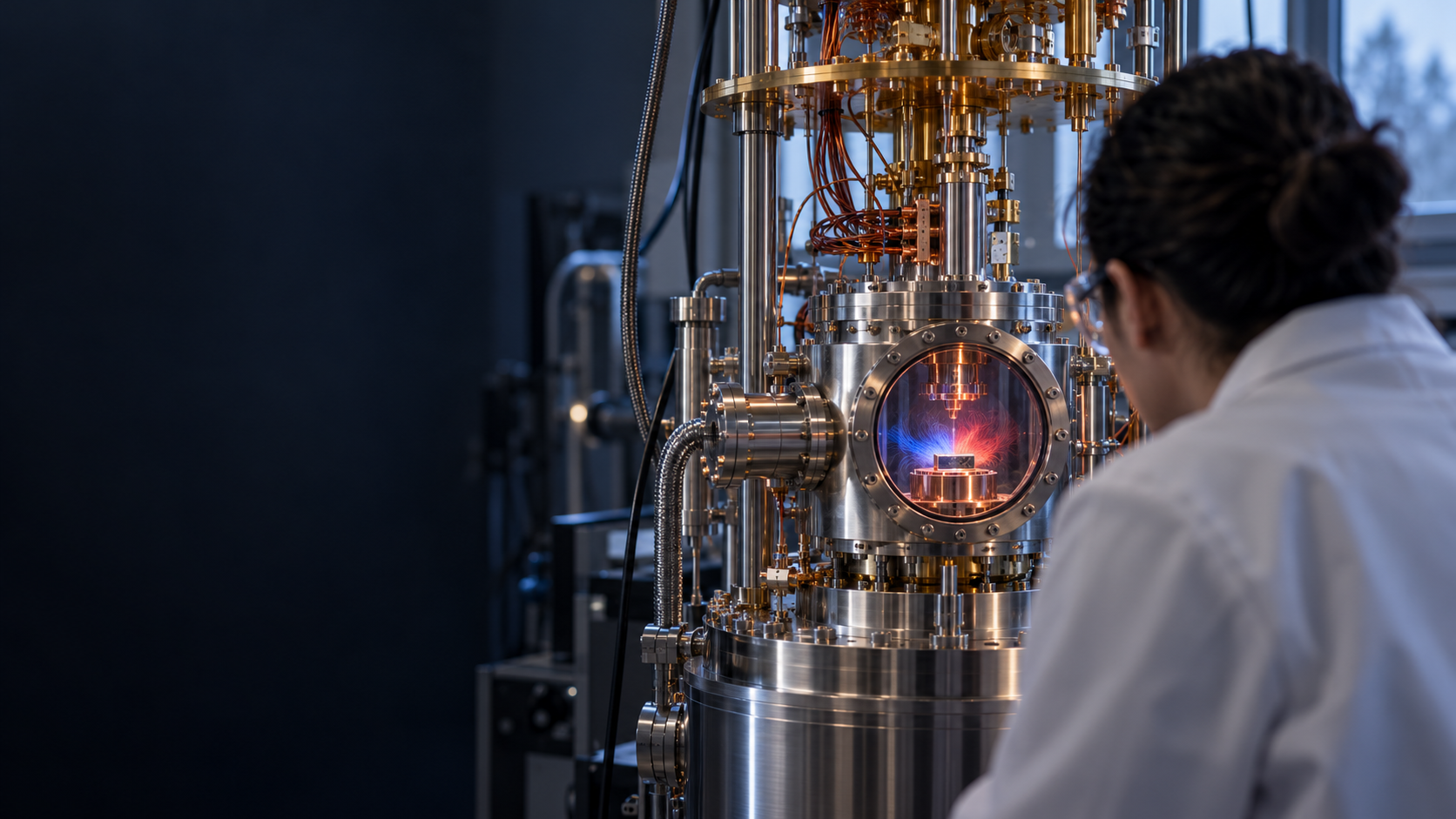
The “cage” is not a physical structure. It is an engineered arrangement of electric and magnetic fields.
Charged particles can be confined in devices called Penning traps. A Penning trap combines a strong magnetic field with electric fields. The magnetic field forces the particle into controlled circular motion, while the electric field confines it along the apparatus’s axis.
The particle does not remain motionless. It can orbit, oscillate, and move in several coupled modes. These motions depend on the particle’s mass, charge, energy, and the strength and geometry of the applied fields.
Neutral antimatter atoms require a different approach. Because they have no net electric charge, electric fields cannot confine them in the same way. However, neutral atoms may respond to magnetic-field gradients through their magnetic moments. Magnetic traps can therefore hold antihydrogen under carefully selected conditions.
The exact trap design depends on the particle and the measurement. A charged antiproton, a positron, and a neutral antihydrogen atom do not behave identically. The original research paper must establish which particle was trapped, which fields were used, and what was measured.
Why One Particle Is Useful
A single trapped particle can produce a long sequence of measurable events. Researchers may observe its oscillation frequency, energy changes, spin behavior, or response to controlled changes in the fields.
This approach offers several advantages:
- Isolation: The particle avoids collisions with other particles and surrounding matter.
- Repeatability: The same particle can be measured many times.
- Event identification: Researchers can associate a signal with one known particle rather than an unknown mixture.
- Reduced sample complexity: A large population may contain particles in different energies or states.
- Sensitive comparisons: Small differences between matter and antimatter can be investigated under similar conditions.
Isolation does not eliminate uncertainty. It changes the uncertainty problem. Instead of dealing mainly with collisions and population differences, researchers must control field stability, detector noise, temperature, timing, and theoretical corrections.
Environmental Control
Precision antimatter experiments typically require:
- Ultra-high vacuum.
- Very stable magnetic fields.
- Low temperatures where appropriate.
- Reduced mechanical vibration.
- Shielding from electrical noise.
- Accurate timing and frequency references.
- Repeated calibration against known standards.
A particle may remain trapped for a long period, but the apparatus itself is never perfectly static. Magnetic fields drift, electronics generate noise, nearby materials produce unwanted fields, and thermal changes alter components. The experiment must measure or limit these effects.
What Scientists Can Learn from One Trapped Antimatter Particle
Depending on the experimental design, researchers may determine or constrain:
- Charge-to-mass ratio.
- Magnetic moment.
- Energy levels.
- Spin-related behavior.
- Response to electric and magnetic fields.
- Lifetime and stability.
- Transition frequencies.
- Motion under controlled forces.
A measured quantity is not always observed directly. Scientists may infer a property from a frequency, trajectory, or transition between energy states. That inference depends on a theoretical model and a detailed uncertainty budget.
Repeated measurements allow researchers to test whether antimatter agrees with the predictions of the Standard Model, the framework describing known elementary particles and their interactions.
Agreement is important. Precision experiments can rule out proposed theories, narrow the allowed size of unknown effects, and establish stronger limits on new interactions. A result does not need to contradict theory to be scientifically valuable.
Testing Matter–Antimatter Symmetry
Modern physics expects matter and antimatter to follow closely related rules. Their masses should match, while their charges should have opposite signs but equal magnitudes. Corresponding energy transitions should agree when the comparison accounts for reversed charge and other relevant properties.
These tests examine fundamental symmetries, including charge, parity, and time reversal. A confirmed difference between a particle and its antiparticle could challenge the Standard Model or reveal an interaction not included in current theories.
A difference in measured values is not automatically a physical difference. It may arise from:
- Magnetic-field drift.
- Imperfect trap geometry.
- Detector calibration.
- Temperature changes.
- Background radiation.
- Data-selection choices.
- Missing theoretical corrections.
- Statistical fluctuation.
For this reason, a headline about a “revolution” should not be treated as evidence of a new theory unless the underlying result has passed statistical and experimental tests.
The Larger Questions Behind the Experiment
Why Does the Universe Contain More Matter Than Antimatter?
The early universe appears to have produced matter and antimatter in nearly comparable amounts under simple assumptions. If the balance had remained exact, matter and antimatter would have annihilated, leaving little material from which stars, planets, and living systems could form.
The observable universe is instead dominated by matter. This imbalance, called the matter–antimatter asymmetry, remains one of physics’ major unanswered questions.
Precision antimatter experiments can test whether matter and antimatter have subtle differences. Such differences might help explain how the asymmetry developed. However, a single trapped-particle experiment is unlikely to solve the entire problem. It may constrain theories or expose a discrepancy that points toward a broader explanation.
Does Antimatter Respond to Gravity Like Matter?
General relativity predicts that antimatter should respond to gravity according to the same basic law as matter. Testing that prediction directly is difficult.
Gravity is weak compared with electric and magnetic forces. Charged antimatter particles are especially unsuitable for simple gravity tests because electromagnetic fields strongly influence their motion. Neutral antihydrogen is often more appropriate because its overall electric charge is zero, although it remains magnetically sensitive and technically challenging to control.
A trapped charged particle can still contribute indirectly to gravitational research or help develop the tools required for future tests. The particle type and apparatus determine what conclusion is possible.
Quantum Mechanics and Macroscopic Measurement
A trapped antimatter particle is a quantum object, but its behavior can be measured through macroscopic equipment. Detectors, superconducting circuits, timing systems, and computers translate tiny changes into observable signals.
This strategy resembles other precision experiments in quantum physics. Research on superconducting electrical circuits demonstrated quantum tunneling and energy quantization in systems large enough to be considered macroscopic. The 2025 Nobel Prize in Physics recognized John Clarke, Michel H. Devoret, and John M. Martinis for this work, according to the supplied Nature summary Source 7.
The comparison has limits. Superconducting circuits make quantum effects visible in larger engineered systems, while trapped antimatter isolates an individual particle or atom for precision testing. Both approaches show how carefully controlled measurements can probe the boundary between theory and observation.
Precision Physics Requires Reliable Standards
Modern measurement science increasingly defines units through reproducible constants rather than unique physical objects. On 20 May 2019, the kilogram was redefined using a fixed value of the Planck constant instead of a platinum–iridium prototype Source 9.
The kilogram change does not establish any result about antimatter. It illustrates a related principle: precision depends on reproducible procedures, stable references, calibration, and transparent uncertainty analysis.
Antimatter measurements must remain comparable across years and laboratories. Researchers need reliable frequency standards, field measurements, detector calibration, and theoretical calculations. Without that infrastructure, an apparent difference may reflect the apparatus rather than nature.
Long-term facilities are therefore part of the scientific result. Nature has reported that UK physics facilities face pressure to commercialize their operations or close, raising concerns about funding and viability Source 3. Difficult measurements often require years of development, specialist staff, stable equipment, and international collaboration. Closing a facility can interrupt multi-year datasets, detector development, training, and independent replication.
What the Experiment May—and May Not—Prove
A scientifically significant result could include:
- A confirmed difference between matter and antimatter properties.
- A new limit on an unknown interaction.
- A reproducible violation of an expected symmetry.
- A measurement that excludes major classes of theoretical models.
- A substantial improvement in antimatter storage or measurement precision.
The strongest claims require more than one unusual observation. Researchers must determine whether the result is statistically significant and whether systematic errors have been controlled. Independent laboratories should be able to reproduce the finding using different equipment or methods.
One trapped particle also does not represent every form of antimatter under every condition. A charged antiproton, a positron, and neutral antihydrogen test different aspects of physics. Results must be described within the limits of the actual experiment.
Where Neutrino Research Fits
Neutrino research appears in the same broad conversation because it also uses precision measurements to investigate gaps in established physics.
One supplied Nature summary describes a proposed solution to the long-standing mystery of missing neutrinos but provides no technical details Source 1. Another reports tighter constraints on neutrino mass Source 5.
These subjects are connected by method, not direct evidence. Antimatter experiments study particle–antiparticle symmetry and related properties. Neutrino experiments study oscillations, mass, interactions, and cosmological effects. A neutrino result does not explain a trapped-antimatter measurement.
Future Scientific Impact
In the near term, improved single-particle experiments could provide:
- More accurate matter–antimatter comparisons.
- Stronger tests of fundamental symmetries.
- Better limits on theories beyond the Standard Model.
- More sensitive searches for weak or unknown interactions.
- Improved techniques for cooling and manipulating antimatter.
Longer-term work may support gravity tests with neutral antimatter, higher-precision antihydrogen spectroscopy, quantum sensors, and advanced timing systems. Results could also be compared with evidence from particle colliders, neutrino observatories, and cosmological surveys.
The work does not make antimatter energy or propulsion practical. Production rates remain extremely low, costs are high, storage is difficult, and annihilation creates major engineering and safety challenges. A trapped particle has enormous value as a scientific probe, not as a near-term fuel source.
Conclusion: Why One Particle Matters
A single trapped antimatter particle can act as an exceptionally sensitive probe of fundamental laws.
Field-based confinement prevents immediate contact with matter. Isolation enables repeated measurements. Comparisons with ordinary particles test symmetry principles at high precision. An unexpected, reproducible difference could reveal new particles, forces, or interactions beyond current theories.
The strongest conclusion is measured: the technique opens a path to potentially transformative physics, but it does not prove that physics has already undergone a revolution.
Researchers must improve confinement, reduce systematic errors, repeat measurements, compare results across laboratories, and test every observation against established theoretical predictions. In fundamental physics, one particle can change the questions scientists ask—but only rigorous evidence can change the laws they accept.
Frequently Asked Questions
What is an antimatter particle?
An antimatter particle is the counterpart of a matter particle with the same mass and opposite electric charge or related quantum properties. A positron, for example, is the antimatter counterpart of an electron.
How can scientists trap antimatter without letting it touch matter?
Scientists use electromagnetic fields inside a vacuum. Electric and magnetic fields can confine charged particles, while magnetic traps can hold some neutral antimatter atoms. The fields act as an invisible cage.
Why is studying one antimatter particle useful?
A single particle can be isolated from collisions and monitored repeatedly. Researchers can measure its motion, energy, or response to external fields and compare the results with precise theoretical predictions.
Could one trapped particle prove that current physics is wrong?
No. A surprising measurement would require statistical analysis, systematic-error checks, repeated observations, and independent confirmation before supporting a revised theory.
Does this research make antimatter energy or propulsion practical?
No. Trapping one particle demonstrates experimental control, not an efficient energy technology. Antimatter remains extremely difficult and expensive to produce and store.
How do neutrino and antimatter research connect?
Both use precision measurements to investigate unanswered questions in fundamental physics. They involve different particles, experiments, and evidence, so neutrino findings should not be presented as direct proof about trapped antimatter.
Artikel Terkait
-
 AI Agent Virtual Island Experiment Explained
-
 Orionid Meteor Shower Peaks Tonight: How to Watch
-
 Astronomers Reportedly Find a Mysterious Green Star
-
 Orionid Meteor Shower Peaks Tonight: Best Viewing Time
-
 SpaceX’s Reported Starfall Launch: What We Know
-
 Spin Fluctuations May Explain High-Temperature Superconductivity