Japan’s Historic Mission to Return a Phobos Sample
Japan’s Historic Mission to Return a Phobos Sample
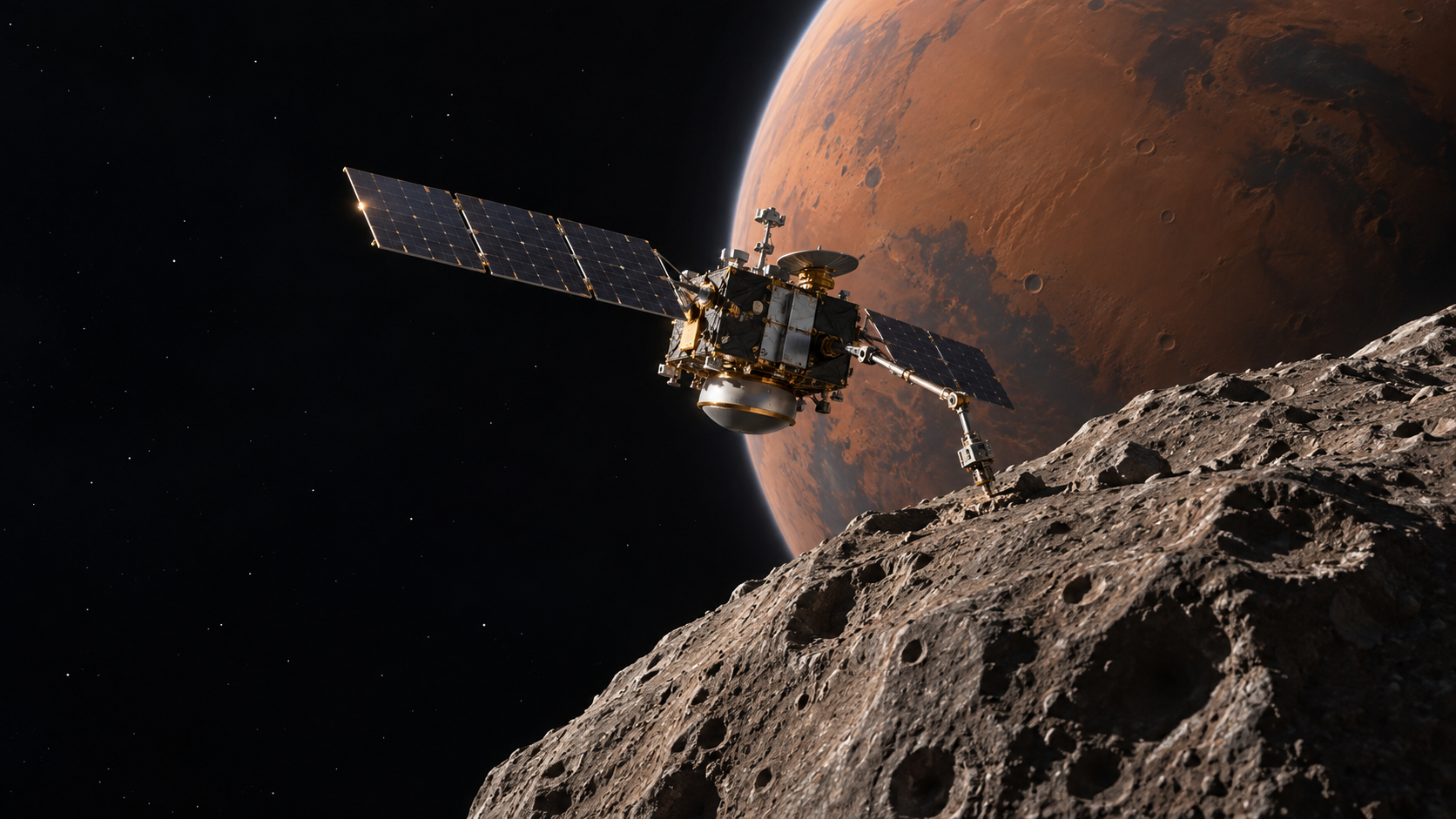
Japan has launched an uncrewed spacecraft toward Phobos, one of Mars’ two small moons, in a mission designed to collect surface material and return it to Earth. If successful, the mission could become the first to retrieve material directly from Phobos for laboratory study. Source 1
The mission addresses fundamental questions about Phobos. Scientists want to determine whether the moon is an asteroid captured by Mars, debris produced by a massive impact, or the result of another process during the early formation of the solar system. A returned sample could provide evidence that remote observations cannot deliver.
What Is Phobos?
Mars has two natural satellites: Phobos and Deimos. Phobos is the larger and closer moon. It is irregularly shaped, dark and heavily cratered, resembling a rocky small body more than a spherical planetary satellite.
Its close orbit places it in an environment shaped by Mars’ gravity, impacts and debris. Material on its surface may record processes that affected both the moon and its planet. Debris ejected from Mars by impacts may have reached Phobos, while Phobos material may have been distributed throughout the Martian system.
Phobos has extremely weak gravity. A spacecraft approaching its surface must therefore operate differently from a lander traveling to a large planet or moon. The weak gravitational pull makes it difficult to remain near the surface and increases the risk of bouncing away after contact.
Remote observations can reveal Phobos’ shape, brightness and mineral signatures, but they have limits. Earth-based laboratories can analyze returned material with greater precision, repeat measurements and apply specialized instruments that cannot be sent into space.
Mission Goals
The primary objective is to investigate Phobos, collect surface material and return it to Earth. Reports describe the spacecraft as an uncrewed vehicle launched toward the moon for this purpose. Source 3
Researchers could examine the sample for:
- Mineral composition
- Elemental abundance
- Chemical signatures
- Isotopic ratios
- Physical structure
- Signs of alteration
- Possible evidence of water-related processes
The results could help distinguish among competing origin theories. An asteroid-like composition would support a captured-body explanation. Strong similarities to Martian material would make formation from impact debris more plausible. Mixed characteristics could point to a more complex history.
Phobos may also preserve clues about the early Martian system. Its surface has been exposed to impacts and radiation, but the moon has not undergone the same large-scale geological evolution as Earth or Mars. Returned material could contain evidence of ancient impacts, Martian debris, primitive solar-system compounds and the evolution of Mars and its moons.
How the Mission Will Work
The mission involves a complex sequence:
- Departure from Earth
- Cruise through interplanetary space
- Arrival in the Martian system
- Observations and trajectory operations
- Approach to Phobos
- Controlled surface contact
- Sample acquisition
- Departure from the Martian system
- Return toward Earth
- Capsule recovery and sample analysis
Small navigation errors can affect every later phase, particularly the approach to Phobos. The spacecraft must operate within the gravitational influence of both Mars and its moon while maintaining precise control of its trajectory.
Before attempting contact, the spacecraft is expected to study Phobos’ shape, terrain and rotation. These observations can help engineers select a sampling location and plan a safe approach.
Touch-and-Go Sampling
A touch-and-go operation can avoid the need for a conventional landing, but it remains technically demanding. The spacecraft must approach at the correct speed and angle, interact with uncertain terrain, collect material quickly and avoid losing stability.
Potential hazards include:
- Loose dust and regolith
- Uneven terrain
- Uncertain surface strength
- Low gravity
- Limited contact time
- Spacecraft rebound
- Difficulty departing after contact
Contamination control is also essential. Earth materials must not alter the sample, and the recovered material must be handled under controlled conditions after its return.
Returning the Sample
After collection, the spacecraft must secure the material, leave Phobos, depart the Martian system and travel back toward Earth. A return capsule would then separate, reenter the atmosphere and be recovered for controlled analysis.
Earth arrival does not end the technical challenge. Recovery teams must locate and secure the capsule, preserve the sample and transfer it to facilities equipped to study material from another planetary environment.
Why a Phobos Sample Matters
Earth laboratories can provide higher measurement precision, larger instruments, repeated testing, independent analysis by multiple research groups and long-term sample preservation. Scientists can divide a sample among specialist teams and reserve portions for future technologies.
Researchers may compare Phobos material with asteroid samples, meteorites, Martian rocks and other planetary materials. Mineral, chemical and isotopic evidence could reveal whether Phobos is related to primitive asteroids, Mars or neither.
A returned sample would also provide a physical reference for interpreting future spacecraft observations. Instead of relying only on spectral matches, scientists could compare remote measurements with known material from Phobos.
The mission could improve understanding of:
- How Mars formed
- How planetary moons developed
- How material moved through the early solar system
- How impacts shaped planets and satellites
- How captured asteroids evolve around planets
The sample’s value could increase over time as new instruments and analytical methods become available.
Major Mission Challenges
Weak Gravity
Phobos’ weak gravity means the spacecraft cannot rely on gravity to remain near the surface. Precise propulsion and navigation are required during approach, contact and departure. A small trajectory error could cause the spacecraft to miss the target, strike it too hard or drift away.
Uncertain Terrain
Surface conditions are not known in complete detail. Engineers must account for dust depth, rock distribution, surface hardness, loose material, slopes and local changes in stability. A site that appears safe from a distance may contain unexpected hazards.
Contamination
The mission must prevent terrestrial material from entering the sample and avoid altering the sample during recovery and analysis. Even minor contamination could complicate investigations of chemical or isotopic differences.
The Return Journey
A successful launch does not guarantee a successful sample return. Mission success depends on reaching the Martian system, contacting Phobos, collecting material, securing the sample, departing safely, returning to Earth and recovering the capsule intact.
Relevance to Future Exploration
Most Mars missions focus on the planet’s surface, atmosphere or orbit. A Phobos mission offers another way to investigate the Martian system. The moon’s proximity to Mars makes it scientifically valuable, while its low gravity creates a distinctive operational challenge.
The mission combines remote sensing, small-body navigation and sample return. Success could strengthen expertise in exploring small bodies beyond the near-Earth environment.
Information about Phobos’ surface, gravity and orbital environment could also support future robotic and human missions by improving navigation, communications planning, resource assessment and the selection of possible staging locations.
What Scientists Could Learn
Chemical and isotopic evidence could test the leading theories about Phobos’ origin. An asteroid-like composition could support capture by Mars. Strong similarities to Mars could support formation from Martian debris after a major impact. Mixed characteristics could indicate that Phobos formed through several processes or accumulated material from different sources.
If the sample includes material from Mars, it could provide indirect information about the planet’s early evolution. Ancient impact fragments or Martian dust may have reached Phobos and become incorporated into its surface, although laboratory measurements would be needed to confirm any Martian contribution.
Phobos could also contain primitive material from the early solar system. Comparisons with asteroids, meteorites and planetary samples may reveal how material was distributed during planetary formation.
Mission Milestones to Watch
Key milestones include:
- Cruise to Mars
- Arrival in the Martian system
- Detailed observations of Phobos
- Safe approach to the surface
- Sample acquisition
- Secure sample storage
- Departure from Mars
- Earth return
- Capsule recovery
- Confirmation of sample integrity
Operational and scientific success are separate achievements. Reaching Phobos would demonstrate navigation capability. Collecting material would represent a further milestone. Returning usable material would complete the mission’s central objective, while interpreting the sample could take years.
Conclusion
Japan’s mission aims to transform Phobos from a distant mystery into a laboratory specimen. If successful, it could become the first mission to return material from the Martian moon. Source 5
The scientific goals extend beyond Phobos itself. The mission could investigate the origin of Mars’ satellites, test theories about small-body formation, study the early Martian system and expand sample-return capabilities. Its findings may influence future robotic and human exploration of Mars and its moons.
Frequently Asked Questions
What is Japan’s Phobos mission?
It is an uncrewed mission designed to investigate Phobos, collect surface material and return the sample to Earth for laboratory analysis.
Why is Phobos important?
Phobos may preserve clues about the formation of Mars and its moons. Its composition could reveal whether it is a captured asteroid, material formed from Mars or the result of another process.
Would this be the first sample returned from Phobos?
If the spacecraft successfully collects material and brings it back to Earth, it could become the first mission to return a sample from Phobos. Source 9
What could scientists learn from the sample?
Researchers could study its minerals, chemistry, isotopes, physical structure and possible signs of alteration. These results could reveal Phobos’ origin and provide information about the early Martian system.
Why is landing on Phobos difficult?
Phobos has very weak gravity and an irregular surface. The spacecraft must control its approach carefully, remain stable during contact and preserve its ability to depart.
When will scientists know the results?
Initial findings could come from spacecraft observations and mission milestones. Detailed laboratory results would become available only after the sample reaches Earth, is recovered and undergoes controlled analysis.
Artikel Terkait
-
 Rolling Snakes and Nature’s Wheel-Like Solutions
-
 Space Jellyfish May Reappear During SpaceX Launch
-
 Hera Mission to Reveal DART’s Asteroid Impact Damage
-
 Japan’s Mission to Return Samples From Mars’s Moons
-
 Orionid Meteor Shower 2026 Cloud Cover Forecast
-
 How Wildfires Affect Fire-Following Beetles and Ticks