M87* Black Hole Image Holds Up Under New Analysis
M87* Black Hole Image Holds Up Under New Analysis
The first image of a black hole remains one of astronomy’s strongest visual discoveries—even after researchers processed the original observations with a new machine-learning method.
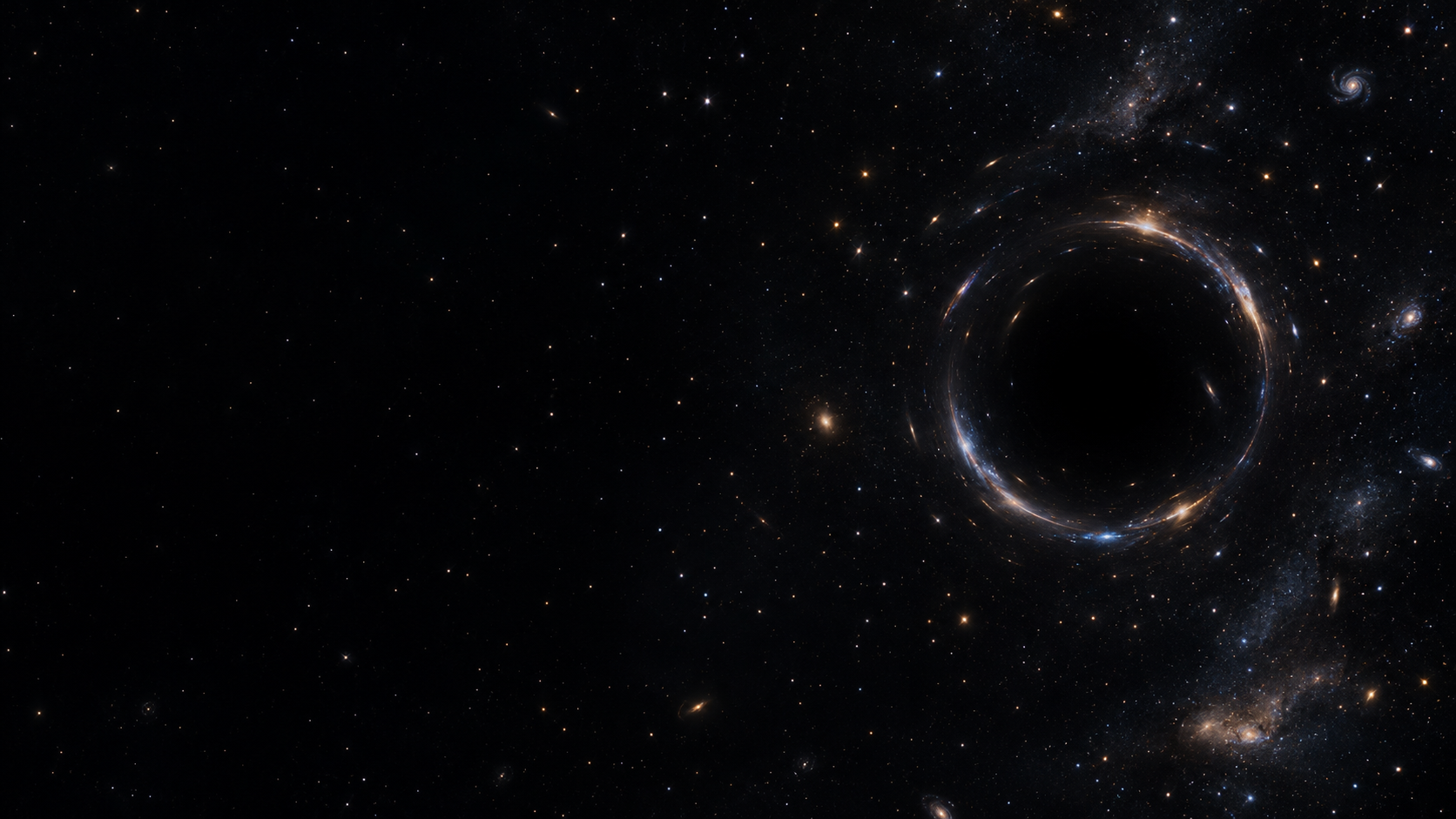
Released in 2019, the image showed M87*, the supermassive black hole at the center of the galaxy Messier 87. Its most recognizable features were a bright, uneven ring surrounding a dark central region. The image appeared fuzzy because the Event Horizon Telescope (EHT) reconstructed it from sparse radio observations collected by observatories around the world.
A refined reconstruction now presents the ring more clearly and makes it appear thinner. The central shadow and the estimated size of the structure remain consistent with the original result. The new image does not replace the first image or reveal an entirely different black hole. Instead, it strengthens confidence that the 2019 observation captured a genuine astrophysical feature rather than an artifact of one imaging method. Source 5
The result illustrates how scientists test difficult observations: they apply independent reconstruction techniques, compare the outcomes with the original data and check whether key structures remain physically plausible.
What the 2019 Image Revealed
M87* is a supermassive black hole at the center of the galaxy Messier 87. The black hole itself does not shine like a star or planet. Instead, the EHT detected radio emissions from the extremely hot gas and plasma surrounding it.
The famous image is not a conventional photograph of a solid object. It is a radio-image reconstruction showing the environment around M87* and the dark silhouette created by the black hole’s gravity.
The bright ring consists of radiation from hot material near the black hole, combined with light whose path has been strongly bent by gravity. The dark central region is the black-hole shadow. It is not a photograph of the event horizon’s surface. The event horizon is the boundary beyond which light cannot escape, while the shadow is a larger apparent dark region created by the way light moves around the black hole.
The ring is not perfectly uniform. Relativistic effects alter the appearance of rapidly moving gas, making one side brighter than another. The viewing angle and plasma structure also contribute to the image’s asymmetry. Source 7
The image was a scientific milestone because it provided direct visual evidence of a black hole’s shadow. Earlier studies had detected black holes through their effects on nearby stars, gas and radiation, but M87* offered a direct view of the dark region produced by extreme gravity.
The EHT did not record the image in a single exposure. It linked radio observatories around the world, allowing them to act as an Earth-sized virtual telescope. The array collected measurements from different telescope pairs, then used mathematical imaging methods to reconstruct the most likely structure supported by those measurements.
Why the Original Image Looked Fuzzy
Even an Earth-sized virtual telescope has finite resolution. The array samples selected locations and directions rather than every measurement needed for a perfectly detailed image. Researchers must therefore reconstruct unmeasured portions using the available data, calibration information and assumptions about the source.
The original observation could identify the broad ring and shadow while leaving finer details uncertain. Its fuzzy appearance reflected the limits of the data and reconstruction process, not a lack of scientific value.
Image reconstruction is not simple sharpening. Radio-frequency measurements must be calibrated, combined and interpreted with mathematical algorithms. The goal is to find an image that agrees with the observations. Different algorithms may produce slightly different visual details, particularly when the data are sparse.
A credible feature must remain compatible with the underlying measurements and survive tests against alternative methods. Researchers cannot recover information unsupported by the observations, but they can use statistical methods and physical knowledge to estimate which structures best explain the evidence.
How Machine Learning Produced a Clearer View
Researchers applied a machine-learning technique to the original EHT observations. The method produced a reconstruction with a narrower, more clearly defined ring around the dark central shadow. It did not collect new observations or photograph M87* again.
The comparison is straightforward:
- The original reconstruction showed broader, fuzzier bright emission.
- The refined reconstruction showed a thinner, more distinct ring.
- Both reconstructions showed a similar dark center and overall structure.
- The refined image supported earlier estimates of M87*’s apparent size.
The main conclusion is not that machine learning discovered a new feature. It recovered a clearer version of a structure already indicated by the EHT data. Source 5
Machine learning can identify patterns efficiently, but it can also generate convincing structures unsupported by real measurements if it is not properly constrained. A reliable reconstruction must be tested with realistic examples, remain compatible with EHT observations, agree with alternative imaging methods and preserve physically plausible structures.
The refined M87* result gains credibility because it preserves the central features found in the earlier reconstruction. Its sharper appearance matters, but its agreement with the original measurements matters more.
Why the Refined Image Supports the Original Measurement
The updated image supports earlier measurements of M87*’s apparent size. The scale of the shadow and surrounding ring is linked to the black hole’s mass and gravitational environment, although the image does not directly measure the physical edge of the event horizon.
The refined image also retains the original ring-like morphology. A narrower ring does not undermine the 2019 image; it clarifies a structure that was already present. This consistency is a robustness check. A radically different result might have suggested that the ring depended too heavily on one algorithm. Instead, the machine-learning reconstruction reaches a similar conclusion from the same observational foundation.
Independent methods do not need to produce identical pixels to support one another. They need to agree on the scientifically important properties: the central shadow, the ring-like emission and the apparent size.
A sharper image is not automatically a more accurate image. Scientific credibility comes from consistency, reproducibility and physical plausibility. Researchers ask whether the image fits the measured data, whether its main features persist under different methods and whether its structure agrees with physical models.
What the Image Does—and Does Not—Show
The M87* image shows:
- The environment immediately surrounding the black hole.
- A bright ring of radio emission.
- A dark central shadow associated with the black hole.
- Light strongly affected by intense gravity.
- A structure consistent with predictions of strong-field gravity.
It does not show:
- The black hole’s interior.
- A literal surface of the event horizon.
- Individual photons crossing the event horizon.
- A complete movie of matter falling inward.
- Every detail of the accretion flow.
The event horizon is the boundary beyond which light cannot escape. The shadow is the apparent dark region formed by the interaction of light paths, the black hole’s gravity and surrounding emission. The shadow is larger than the event horizon and depends on how light travels around the black hole.
How Scientists Test Whether the Image Holds Up
Scientists process the same EHT data with different reconstruction techniques. Agreement across methods increases confidence that shared features originate in the observations rather than in one algorithm.
They also compare the reconstructed image with predictions from general relativity and simulations of hot gas, magnetic fields and light near a black hole. Features that remain stable across reasonable models are more credible than those that depend on one special assumption.
The ring’s general shape and apparent size broadly agree with the expected appearance of a black-hole shadow in a strong gravitational field. This agreement supports the interpretation without proving every detail of the theory.
Researchers also compare image-based estimates with other observations and models, including black-hole mass, ring diameter and brightness distribution. Agreement among different forms of evidence strengthens the conclusion that the observed structure is real.
What M87* Teaches Scientists About Strong Gravity
M87* provides access to a region where gravity is exceptionally strong. Its image helps scientists study how light bends, how matter moves near a black hole and how relativistic effects shape observed emission. It also offers information about accretion flows, surrounding plasma and the geometry of the central gravitational field.
The ring and shadow are broadly consistent with general relativity’s predictions. The observation supports the theory in an extreme environment, but it does not test every aspect of general relativity or rule out every alternative theory.
More precise tests require better resolution, repeated observations and improved plasma models. Researchers must distinguish effects caused by the gravitational field from effects caused by turbulent material around the black hole.
The Next Target: Sagittarius A*
Sagittarius A*, or Sgr A*, is the supermassive black hole at the center of the Milky Way. It is much closer to Earth than M87*, but its surrounding emission changes more rapidly.
M87* is larger and more distant, while Sgr A* has a smaller apparent structure that varies on shorter timescales because of its lower mass. Dust, gas and other material within the Milky Way also complicate observations.
Studying Sgr A* would allow researchers to compare two supermassive black holes with different masses, environments, accretion activity and viewing conditions. Such comparisons could show which features are universal consequences of black-hole physics and which depend on source-specific plasma behavior. Source 9
What the New Image Means for Astronomy
Improved algorithms can extract more reliable structure from difficult observations. Machine learning can complement hardware advances by helping researchers interpret sparse measurements more efficiently, although software cannot replace additional telescope coverage, stronger calibration or new observations.
Future observations may aim to measure ring diameter more precisely, track changes in surrounding emission, map magnetic fields, study plasma motion and search for departures from expected gravitational behavior. Repeated observations could turn a still image into a record of changing activity.
The refined M87* image demonstrates how science becomes stronger through reanalysis. A new method did not erase the original result. It challenged the reconstruction, improved its clarity and confirmed its key measurements.
Conclusion: A Sharper Image, Not a Different Black Hole
The machine-learning reconstruction of M87* produces a clearer, thinner ring around the dark central shadow. It does not replace the 2019 Event Horizon Telescope image or show a different black hole.
The refined image remains consistent with the original ring structure and estimated size. Its importance lies in the confirmation that the central features of the first image continue to fit the data and the physics of a black hole in a strong gravitational field.
The image does not show the event horizon’s surface or the black hole’s interior. It shows the shadow and surrounding emission created by extreme gravity. Future observations of Sagittarius A* and other black holes will provide further tests, but M87* already stands as a durable scientific achievement because its key result survives independent scrutiny.
Frequently Asked Questions
What was the first image of a black hole?
The first widely recognized image was released in 2019 by the Event Horizon Telescope. It showed the shadow and surrounding bright emission of M87*, the supermassive black hole at the center of Messier 87. Source 7
Did the new machine-learning image replace the original?
No. It is a refined reconstruction of the same EHT data. Its thinner, clearer ring remains consistent with the original image’s measurements and overall structure. Source 5
Is the bright ring the event horizon?
Not exactly. The ring is emission from hot material and light strongly bent around the black hole. The dark central region is the black-hole shadow, which is related to but larger than the event horizon.
Why did the original image look blurry?
The EHT collected sparse radio observations from a global array rather than using a conventional camera. Reconstructing an image from incomplete measurements limits fine detail and produces a fuzzy appearance.
Does the updated image prove general relativity?
It provides evidence consistent with general relativity in the strong-gravity environment around M87*. It does not test every aspect of the theory or rule out all alternatives.
What black hole will scientists study next?
Sagittarius A*, the supermassive black hole at the center of the Milky Way, is a major target. Observing it could provide another test of gravity and reveal how black holes interact with their galactic environments. Source 9